For tech leadsUpdated October 2026
Decide on AI agents with evidence, not demos.
AI Agents for Humans is a practical, vendor-neutral guide for tech leads, engineering managers and CTOs: whether you need an agent at all, whether to build or buy one, how to prove it works before anyone relies on it, and how to run it safely.
- Pages
- 374
- Chapters
- 19
- Appendices
- 7
- Format
Why this book
When an agent project goes wrong, it often starts in one of three places.
- 01
“We need an agent for this.”
A script, a fixed workflow or a person can often do the job for less, with fewer ways to fail. Start from the solution and nobody asks which one the work needs.
Chapter 4The fit test, two gates every task goes through before anyone builds or buys.
- 02
“It worked in the demo.”
A demo is one run, on inputs someone chose. It shows the agent can succeed, and nothing about how often it does on the work you actually get.
Chapter 8An eval set from your own history, every case run more than once, with the pass bar set first.
- 03
“Whose agent is this?”
It started as a side project. Now it’s in production, failures pile up, and nobody can say who approved its permissions.
Chapter 18A named owner for every agent, with the authority to change its permissions or switch it off.
“A script that does the job beats an agent that does it most of the time.”
The core of the book
Four rules for every agent you own
The agent spec, the book’s one artifact, enforces them, and the chapters come back to them by name. Chapter 17 shows all four at work in one agent, from a problem statement to its first month in production.
- 1
Earn the autonomy
Start low on both dials: how much the model decides the steps, and how much a person checks each action. Move up only on evidence.
- 2
Write the evals first
Collect real, anonymized cases and agree a pass bar before you build or buy. The same eval set then judges every vendor and every version.
- 3
Design the context
What the model sees decides what it does: a few tools built around whole jobs, short results, and instructions drawn from the procedures your team already follows.
- 4
Bound the blast radius
Limit what any one mistake can do: an oversight mode for each action, enforced in code, narrow credentials, per-run limits and a tested kill switch.
What’s inside
From the first question to an agent in production
Six parts, in the order you’d meet the work: understand agents, see what they can do, learn how they fail and how to prove one works, decide and design, run it safely, and put it together. Every chapter ends with prompts to copy, common mistakes and a 10-minute exercise, and most exercises fill in one section of your own agent spec.
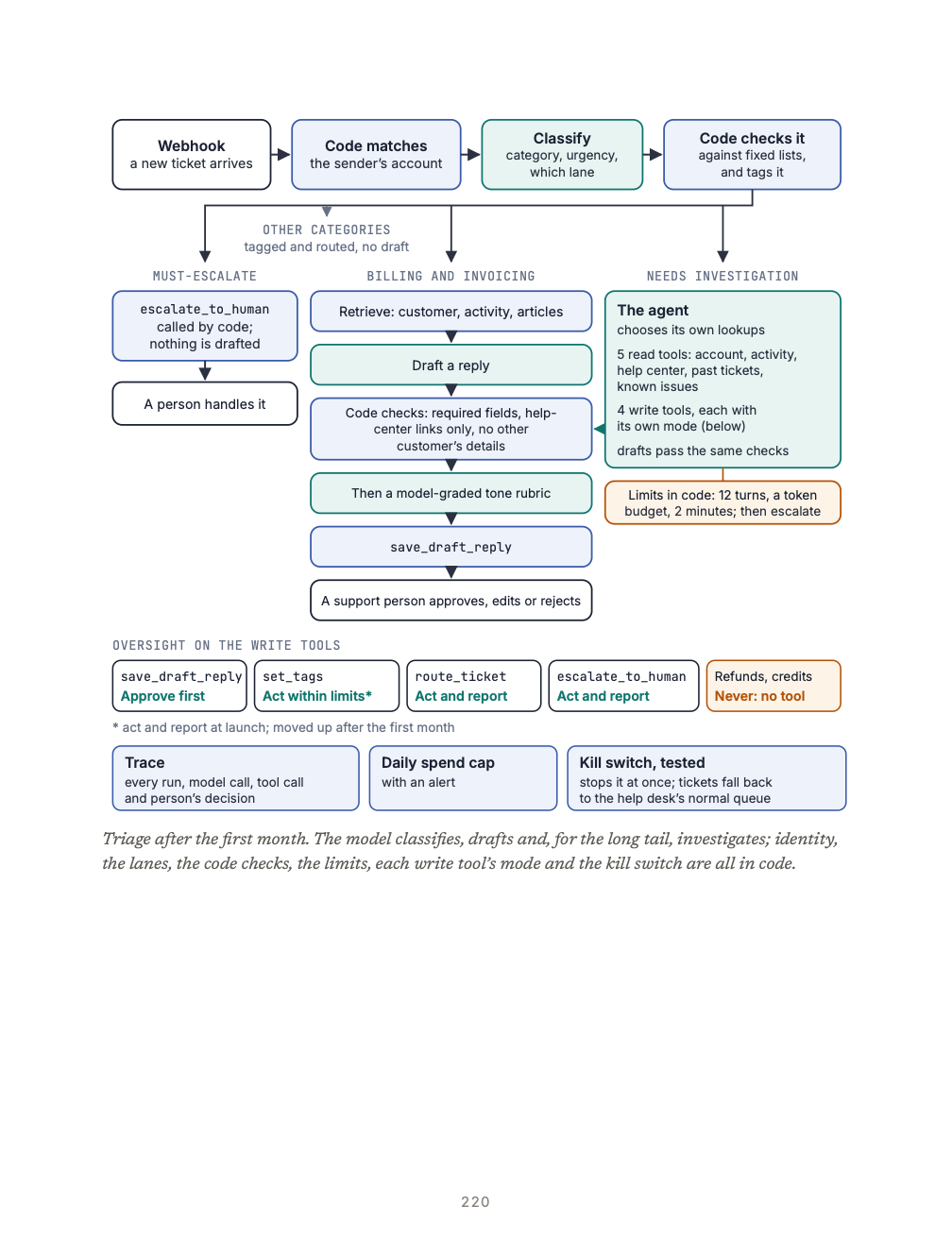
One invented company runs through the book: Fieldline, which makes scheduling and invoicing software for plumbing, HVAC and electrical contractors. The main thread is Triage, a support-ticket agent built end to end in Chapter 17. Beside it run Scout, a read-only on-call helper; Upgrade bot, a coding agent in CI; the help desk vendor’s built-in agent, put through a bake-off; and Collections, the agent Fieldline decided not to build.
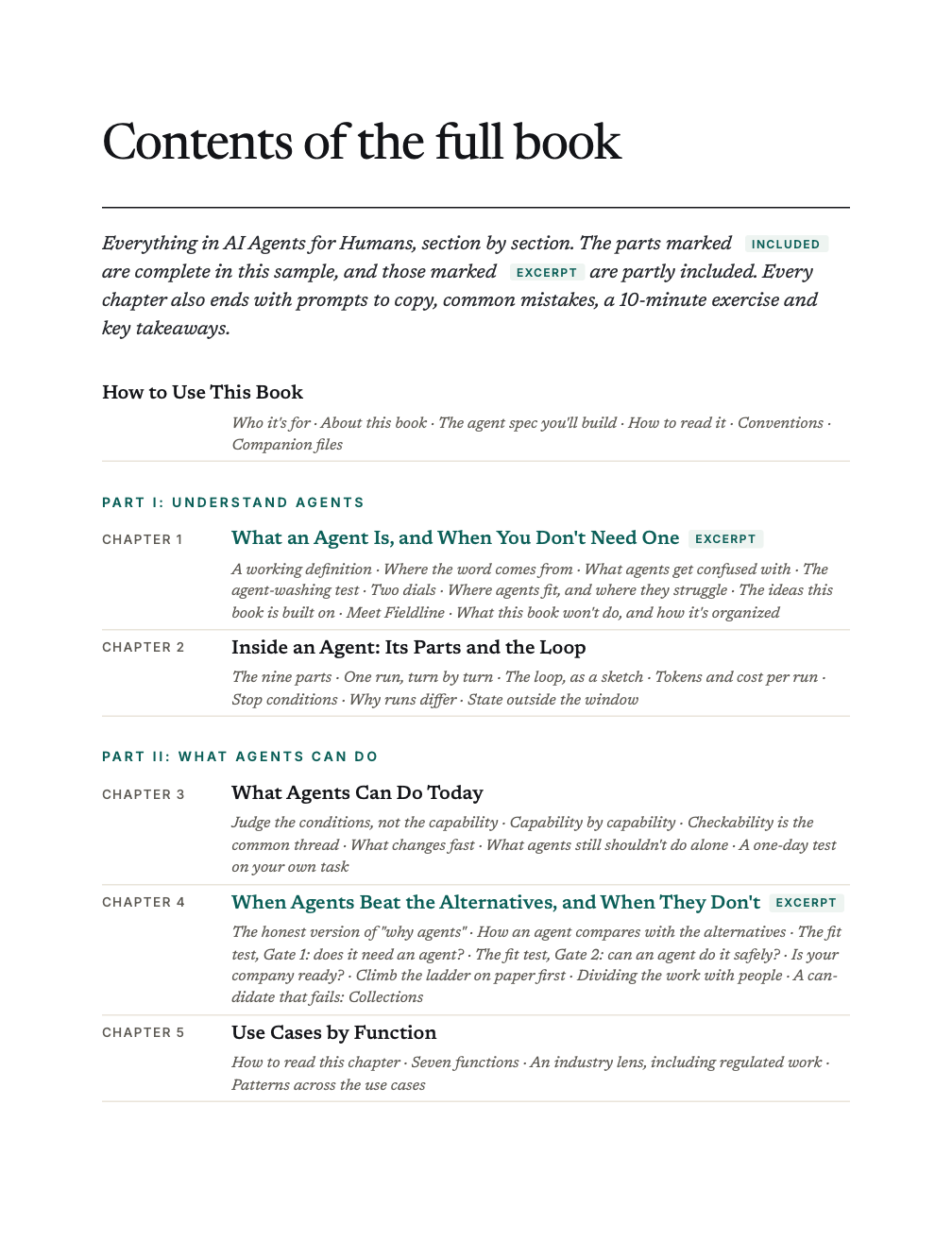
Part I2 chaptersUnderstand AgentsWhat an agent is, how to tell a real one from a relabeled script, and the parts and loop inside every agent.
- 1What an Agent Is, and When You Don’t Need OneBy the end of this chapter you’ll be able to say what an agent is in one sentence, tell a real one from a relabeled script in a vendor pitch, and describe any agent with two separate dials. You’ll also meet Fieldline, the company whose agents run through the book, and write the first lines of your own agent spec.
- 2Inside an Agent: Its Parts and the LoopBy the end of this chapter you’ll be able to name an agent’s nine parts and follow one run turn by turn. You’ll see why cost climbs with every turn, what ends a run and why two runs on the same input can differ, and you’ll start spec section 2.
Part II4 chaptersWhat Agents Can DoWhat agents can do today, when they beat the alternatives, use cases across the business, and what coding agents teach.
- 3What Agents Can Do TodayThis chapter walks through seven things agents can do and the conditions that make each one work or fail at Fieldline. By the end you’ll judge a capability by its conditions rather than its label, and you’ll have a one-day test that adds evidence from your own work to spec section 1.
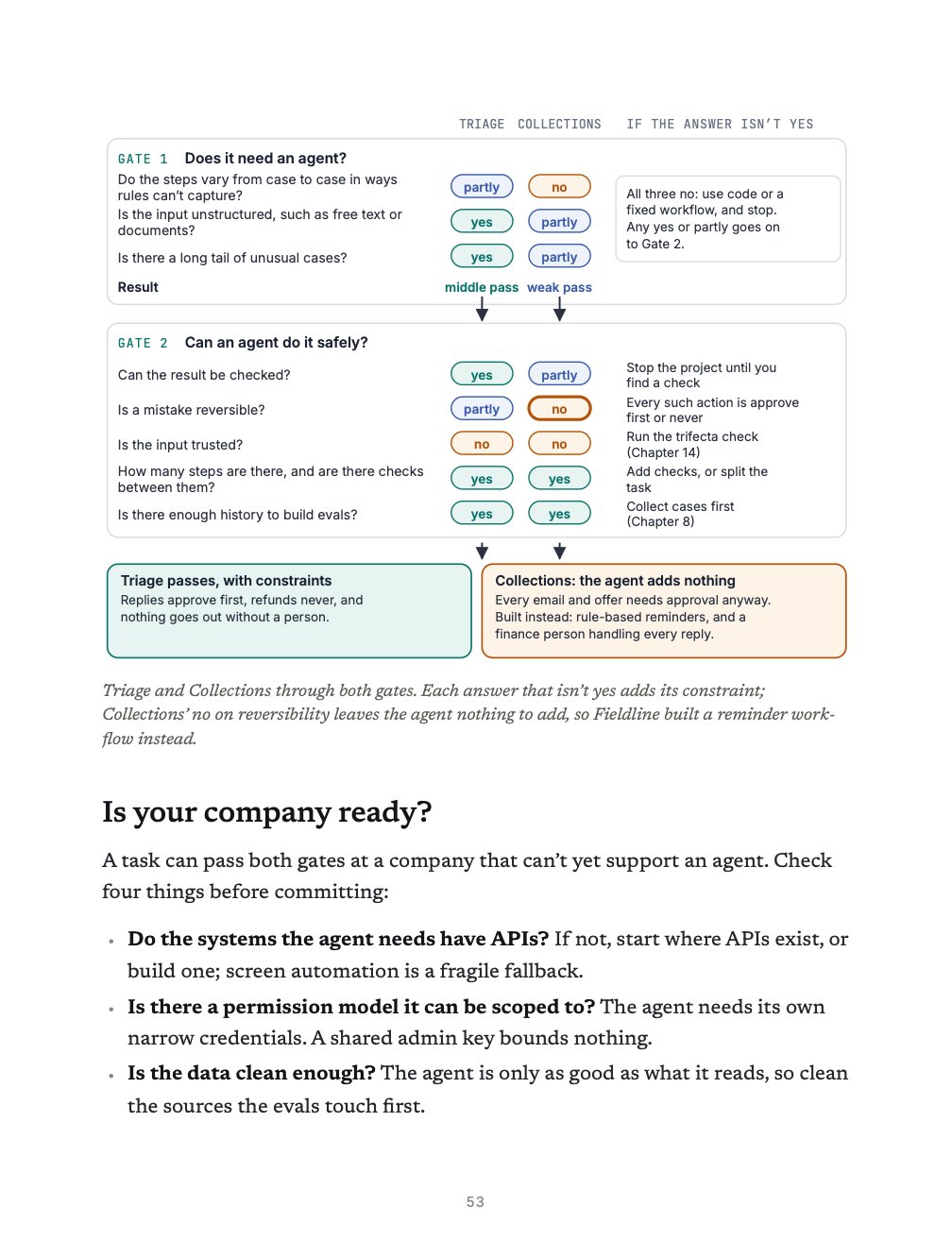
- 4When Agents Beat the Alternatives, and When They Don’tBy the end of this chapter you’ll be able to run any candidate task through the fit test’s two gates and say, with reasons, whether it needs an agent and whether an agent can do it safely. You’ll also be able to compare an agent fairly with cheaper options, check your company’s readiness, and treat a reasoned “no” as a result.
- 5Use Cases by FunctionBy the end of this chapter you’ll be able to spot good agent tasks across the business, and name the task next door that only looks like one. You’ll also know which questions to take to compliance before an agent touches regulated work.
- 6Coding Agents: What They Teach, and Running One in CIBy the end of this chapter you’ll be able to explain why coding agents work as well as they do, and use the same reasoning to judge any agent you’re planning. You’ll also see which of their habits to copy and how Fieldline runs a coding agent in CI, and you’ll draft your team’s coding-agent policy.
Part III2 chaptersWhat Goes Wrong, and How to Prove It Doesn’tA field guide to how agents fail, and the eval set that proves yours works before anyone relies on it.
- 7How Agents Fail: A Field GuideBy the end of this chapter you’ll be able to name the ways agents fail, at four layers, and trace each failure to the design choice that invites it. You’ll also pick the five failures most likely for your own agent, with a control for each, which fills in spec section 3.
- 8Prove It Works: Evals FirstBy the end of this chapter you’ll be able to build a first eval set from your own history, choose a grader for each thing you check, run every case more than once and set a pass bar before you see a result. You’ll also know what public benchmarks can and can’t tell you, and you’ll write spec section 4.
Part IV5 chaptersDecide and DesignBuild, buy or managed service, then the agent’s tools, context, patterns and oversight.
- 9Build, Buy or Managed ServiceBy the end of this chapter you’ll be able to lay out the ways to get an agent, from a feature you already pay for to your own loop, and judge them on five criteria. You’ll know how to read a vendor’s demo or case study, run a bake-off with your own eval set and plan your exit before you sign, and you’ll write spec section 5.
- 10Tools: What Your Agent Can DoBy the end of this chapter you’ll be able to choose a small set of tools for an agent, write descriptions and schemas a model can use, and keep the decision about whose data it touches in your own code. You’ll also know when the Model Context Protocol is worth adopting, and you’ll fill in the tools and permissions part of spec section 2.
- 11Context and InstructionsBy the end of this chapter you’ll be able to decide what goes into your agent’s context and in what order, write a system prompt from the procedures your team already follows, and choose where the agent’s knowledge and memory live. You’ll fill in the context, memory and instructions part of spec section 2.
- 12Patterns: From Workflows to Several AgentsBy the end of this chapter you’ll be able to pick the lowest rung on the design dial that does the job, name the workflow pattern each part of a task needs, and say when one agent, or several, is worth what it costs. You’ll also fill in the loop, stop conditions and per-run limits in spec section 2.
- 13Oversight: What the Agent May Do on Its OwnBy the end of this chapter you’ll be able to give every action your agent can take an oversight mode, with a reason and the evidence that would change it. You’ll know how to make approval fast without turning it into a formality, and you’ll fill in spec section 6.
Part V3 chaptersRun It SafelySecurity and data, running agents in production, and debugging and improving them from the traces.
- 14Security and DataBy the end of this chapter you’ll be able to find the ways an attacker could steer your agent, break the combination that lets one steal data, and decide where your data goes and which questions go to legal. You’ll also fill in spec section 7, the security and data review.
- 15Running Agents in ProductionBy the end of this chapter you’ll be able to see what your agent did on any run, watch the numbers that show it drifting, keep its cost and failures bounded, and roll it out in stages with a way back. You’ll also fill in most of spec section 8, operations.
- 16Debugging and Improving AgentsBy the end of this chapter you’ll be able to take a failed run, find where it went wrong in its trace, and fix it with the cheapest change that works. You’ll prove each fix with your evals, and turn each failure into a new eval case and a sharper spec section 3.
Part VI3 chaptersPutting It TogetherTriage built end to end, leading agent work, and what comes next.
- 17Building Triage End to EndThis chapter follows one agent from a problem statement to its first month in production, one decision at a time, each tied to the chapter that explains it. By the end you’ll have seen the spec’s eight sections work together, and you’ll review your own spec, all of it, against Triage’s.
- 18Leading Agent WorkBy the end of this chapter you’ll be able to say who owns each part of the work, run an agent through the same workflow as any other software, and plan and present it in stages, each with a pass bar. You’ll also know how to measure its value honestly, govern it without a committee and decide when to stop, and you’ll fill in the owner and register entry in spec section 8.
- 19What Comes NextBy the end of this chapter you’ll be able to tell what has already changed from what is only forecast, name the problems nobody has solved, and make the moves that pay off however things turn out. You’ll also add a review cadence to spec section 8.
Reference7 appendicesAppendicesKeep these open while you work.
- AThe Agent Review Kit
- B40 Prompts for Agent Work
- CThe Landscape at the Time of Writing
- DStarter Kit for Builders
- EUse-Case Cards
- FTroubleshooting and Glossary
- GSources
Also in the book
- Afterword: Keep Going
Look inside
A few pages from the book.
This book is for you if…
- You’re a tech lead, engineering manager, staff engineer or CTO at a small or mid-size company
- Someone has asked whether an agent could take on part of your team’s work
- A vendor is pitching an agent, or a colleague’s demo has to become something the business can rely on
- You’ll make the call and own the result, without an AI team to lean on
It’s probably not for you if…
- You want to train or fine-tune models, or learn machine-learning theory
- You want a ranking of vendors and models. The book gives you the criteria and a way to test them
- You want hands-on work with one coding agent. Shipping with Claude Code is written for you
Free sample
Read it before you buy it.
The full contents, section by section, plus these pages from inside the book:
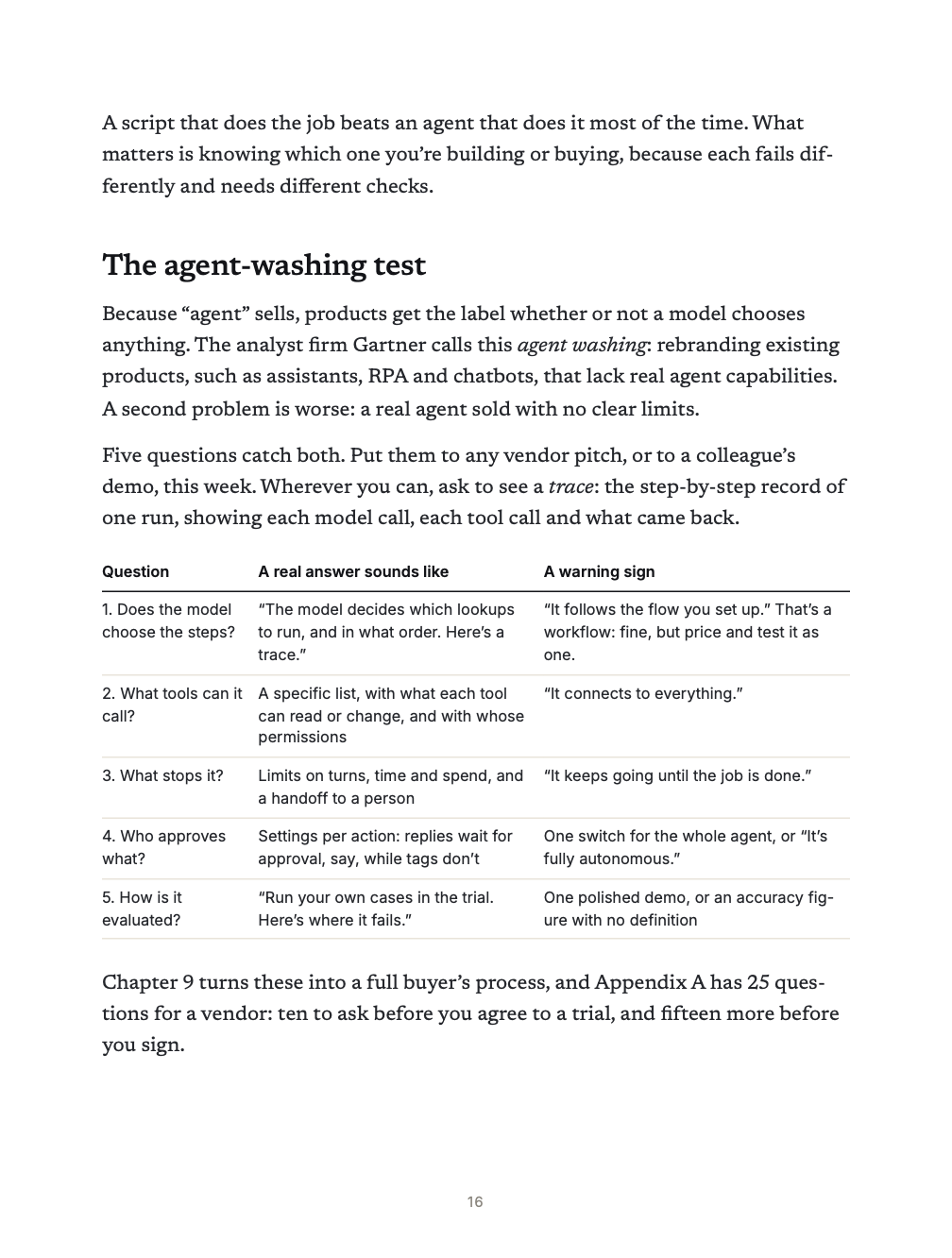
- Chapter 1What an Agent Is: the working definition, the agent-washing test, the two dials and the ideas the book is built on
- Chapter 4When Agents Beat the Alternatives: both gates of the fit test
- Chapter 7How Agents Fail: the model and system failures from the field guide
- Chapter 9How to read a demo or a vendor case study, from Build, Buy or Managed Service
- Appendix AThe first ten questions to ask an agent vendor
- Appendix BThe first 5 of the 40 prompts
A 29-page PDF. No email or sign-up needed, and you’re welcome to share it as long as it stays unchanged and free. See the privacy policy.
The complete book
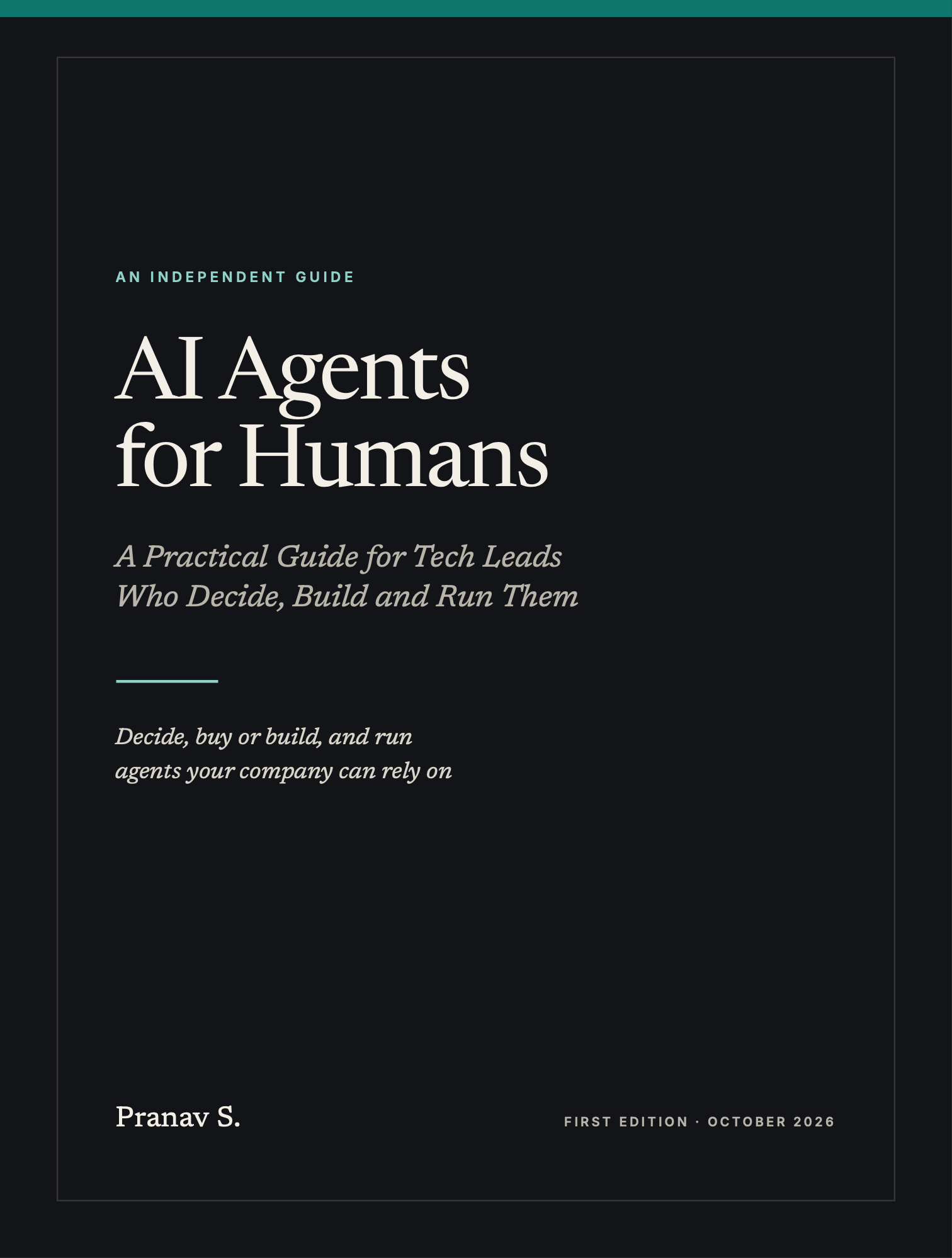
AI Agents for Humans
A Practical Guide for Tech Leads Who Decide, Build and Run Them
- The full 374-page PDF with clickable bookmarks
- 19 chapters, from deciding whether you need an agent to running one in production
- The agent review kit: the blank agent spec, the fit test, 25 vendor questions, and checklists for evals, oversight, security, cost and launch
- 40 prompts to copy, 10 use-case cards, a dated map of the product landscape, and troubleshooting with a glossary
- Companion files: the review kit as editable Markdown, plus starter Python and sample eval cases that run offline
Checkout opens soon. In the meantime, the free sample is yours to read and share.
Read the free sample Leading developers who already use Claude Code? Get all four books togetherThe author
Pranav S. is an independent author. AI Agents for Humans is a practical, vendor-neutral guide for the tech leads, engineering managers and CTOs who decide whether to use an AI agent, buy or build one, and then run it.
Its claims about products, protocols, standards and published guidance were checked against primary sources as of October 2026.
Questions
Before you buy.
Is it tied to one vendor?
Who is it for?
Do I need to write code?
Are the examples real?
Which date is it current to?
How does it fit with the other books?
What do I get, and how is it delivered?
Can I pay in my own currency?
What if it isn’t for me?
Start with the agent you’ve been asked about.
374 pages · 19 chapters